The Last Sleeper
On a train that crosses the country overnight, Leela learns that leaving one home can be a way of arriving inside another.
On a train that crosses the country overnight, Leela learns that leaving one home can be a way of arriving inside another.
Leela was supposed to fly. Everyone agreed on that in the practical, tired way families agree on a thing when it has been discussed for six weeks and already appears in three separate group chats. The wedding was in Bhopal. The train from Mumbai would take eleven hours if it behaved and fourteen if it remembered its own history. The flight was eighty minutes, direct, and arrived at a civilised hour. Her mother had booked it. Her cousin Aadi had sent the boarding pass as a screenshot with a green circle around the gate. Her fiancé, Arun, had texted a single heart and then, ten minutes later, “Please do not become a railway legend the night before the mehndi.”
But her grandmother, Nani, had sat at the kitchen table with the old photograph in front of her. It had been taken at a platform in 1968, and the more Leela looked at it the less it seemed like a wedding picture. There was no garland, no smile arranged for the camera. There were three young women in careful saris, two steamer trunks with white paint on their corners, a boy holding a flask, and a man at the edge of the frame who appeared to be examining the ground as if it had asked him a difficult question. Nani stood in the middle, barely twenty, with a face both certain and not yet decided.
“That was the first time I saw your grandfather afraid,” Nani said. “Not of marrying me. Of missing the train.”
Leela laughed, because the sentence sounded like one of Nani’s perfectly dry corrections. Then her grandmother laid one finger on the picture. “He had never been to my city. I had never been to his. We thought the train would make it simple. You get on at one side, you get off at the other. But all night people told us where we were going. Everyone had an opinion. A man selling tea said his sister lived there. An old woman said the water was bad. A student said the station was impossible. By morning, we had a whole city inside our heads, and none of it was true.”
“You cannot inherit a journey,” Leela said, gentler than she meant to be.
“No,” Nani said. “But you can sit with it.”
The argument began as arguments in this family usually did: quietly, with someone chopping coriander nearby. Her mother said that trains were not symbolic when they were late. Her father said he had once spent seven hours at Itarsi with no food but a packet of glucose biscuits and had survived, which was not evidence anyone accepted. Arun called from Bhopal, where he was attempting to direct florists, cousins, and a band that had arrived a day early. “I love you,” he said, hearing the decision in her silence. “I also know you. If you do this, take Aadi.”
Aadi had been waiting in the hall with two coffee cups. He was the cousin who made contingency plans for other people’s emotions, which meant that every family emergency eventually found him. “I already have the tickets,” he said. “Nani asked me yesterday.”
The last sleeper left just after ten. By then Mumbai had gone dark in patches: apartment windows blinking high above the road, a lit pharmacy, the chrome of a flyover, the occasional kitchen still open to the night. Leela wore jeans and an old cotton shirt, but the sari for the next day lay folded in a garment bag across her lap. In the smaller bag were bangles, her shoes, a scarf her mother wanted her to wear for photographs, and an envelope from the back of Nani’s tin trunk. The paper inside had softened at the folds. Her parents had not known the letters existed.
They were from the year before Nani’s wedding. Seven letters, passed between two cities by hand, through cousins, or in one case with a neighbour travelling for a medical appointment. The writing was ordinary in the most moving sense. Your train was late but I waited. Do not bring mangoes; they will spoil. I saw a yellow house and thought you would like it. One page contained a recipe for lemon pickle, sent in three instalments because the paper was small. Another apologised for the handwriting, then apologised for apologising. There was no grand declaration. There was, instead, the slowly forming grammar of attention.
Their compartment held a retired teacher, a young man travelling to an exam, two sisters returning from a funeral, and a woman with a sleeping child whose shoes had been removed and placed in a neat pair under the seat. The retired teacher asked where they were going. “A wedding,” Aadi said. He had a way of answering questions that made them sound like an opening rather than a conclusion. Within fifteen minutes, he had shown everyone a photograph of Arun, who was caught in the image laughing with his mouth full. The woman with the sleeping child said that this was good; a groom who ate was less likely to become unbearable. The sisters laughed. Leela felt herself relax in a way she had not expected.
At the first long stop, they went down to the platform for tea. It was close to midnight, and the station had the floating unreality of a place that belongs to no one for long. A dog slept against a stack of newspapers. A man in a red cap poured tea from a height that seemed designed to test his wrist. Somewhere at the far end of the platform, two people argued softly and then stopped. Aadi bought salted peanuts, two paper cups, and a magazine that contained a photograph of a foreign city none of them had visited. “What did Nani say was the point?” he asked.
“She didn’t say.”
“That is not like her.”
“She said I could sit with it.”
Aadi looked down the track. “Maybe that is the point. You keep thinking a wedding is where everybody agrees. It is actually where everybody keeps sitting in the same place long enough to become difficult for one another.”
Back in the compartment, Leela read the letters aloud. At first she did it because Aadi asked. Then the retired teacher leaned his head against the wall and listened, and the two sisters paused their whispering, and even the young man studying for an exam looked up when she reached the recipe. By the time she read the line in which her grandfather had written, I do not know the right thing to say, so I will tell you what happened today, the compartment had become a small audience for a life none of them knew. Nobody made it solemn. The woman with the sleeping child said, “This man would have been very bad at texting.” Aadi said, “He would have sent one thumbs-up at eight in the morning and then disappeared.” The train moved on.
At 2:13, the woman across the aisle offered Leela another packet of peanuts. “Eat,” she said. “You do not want to meet a new family on an empty stomach.” It was practical advice. It was also, somehow, a blessing. Leela thought of Arun’s mother, whom she had met four times: once over lunch, once on a video call that kept freezing, once at a bakery where they had disagreed about cake, and once at a family dinner where his mother had pressed a second helping of dal on her without asking. There were so many versions of welcome. Perhaps none of them were elegant. Perhaps that was the point.
Around four, she woke to rain striking the window hard enough to erase the landscape. For a minute, the train seemed not to be travelling anywhere at all. Aadi was asleep with his headphones tangled under his chin. The teacher had wrapped a shawl around his shoulders. The sleeping child had migrated sideways across both seats, one small hand still resting on her mother’s wrist. Leela opened the last letter. It had no date. Her grandfather had written only: I am not worried about the distance. I am worried that when I see you, I will not know where to put all the things I have carried to say.
She read it twice. Then she put it back in the envelope and realised she had been angry with the train for requiring her to be still. The wedding had made everyone talk about the future in crisp, transportable nouns: home, plan, ceremony, move, family. The train offered no nouns at all. It offered waiting, interrupted sleep, strangers’ advice, the inconvenience of being visible to people you would never see again. It was not a tribute to a photograph. It was a rehearsal for the more difficult work: entering a life that already had its own habits and weather, and learning to be changed by it.
At the next station, the retired teacher got down. Before he left, he turned back to the compartment and said, “Do not make the marriage too historic. You have to live in it after.” Everyone laughed except Leela, who felt suddenly close to tears. She had spent months trying to make the wedding intelligible—to both families, to the guests travelling in, to herself. She had made spreadsheets for rooms and cars, revised a seating plan four times, learned the names of Arun’s cousins with a diligence that bordered on superstition. The teacher’s remark did not release her from any of that work. It did something more useful: it separated the event from the life it was supposed to hold.
Aadi woke when the train jolted forward. He asked whether she had slept. Leela said no. He said that was good, because he had been thinking. “When you get there,” he said, “you should tell Arun about the letters.” She looked at the envelope. “I don’t know if they’re mine to tell.” “Maybe not all of them,” he said. “But you can tell him that your grandfather didn’t know where to put all the things he carried to say. That seems relevant.” For once, Aadi did not make the observation into a joke. He simply sat beside her while the rain thinned at the window.
Bhopal arrived after sunrise, delayed but not disastrously. The platform was bright with rain, porters, and the heat beginning to rise from the tracks. Aadi carried the suitcase down first. Leela followed with the garment bag catching on the door, then saw Nani at the gate in a pale blue shawl, furious that no one had sent the arrival time. Her grandmother’s face changed only when Leela reached her. She touched Leela’s cheek with both hands, then took the envelope without asking what was inside.
“Good,” Nani said. “Now you understand why we made the trip.”
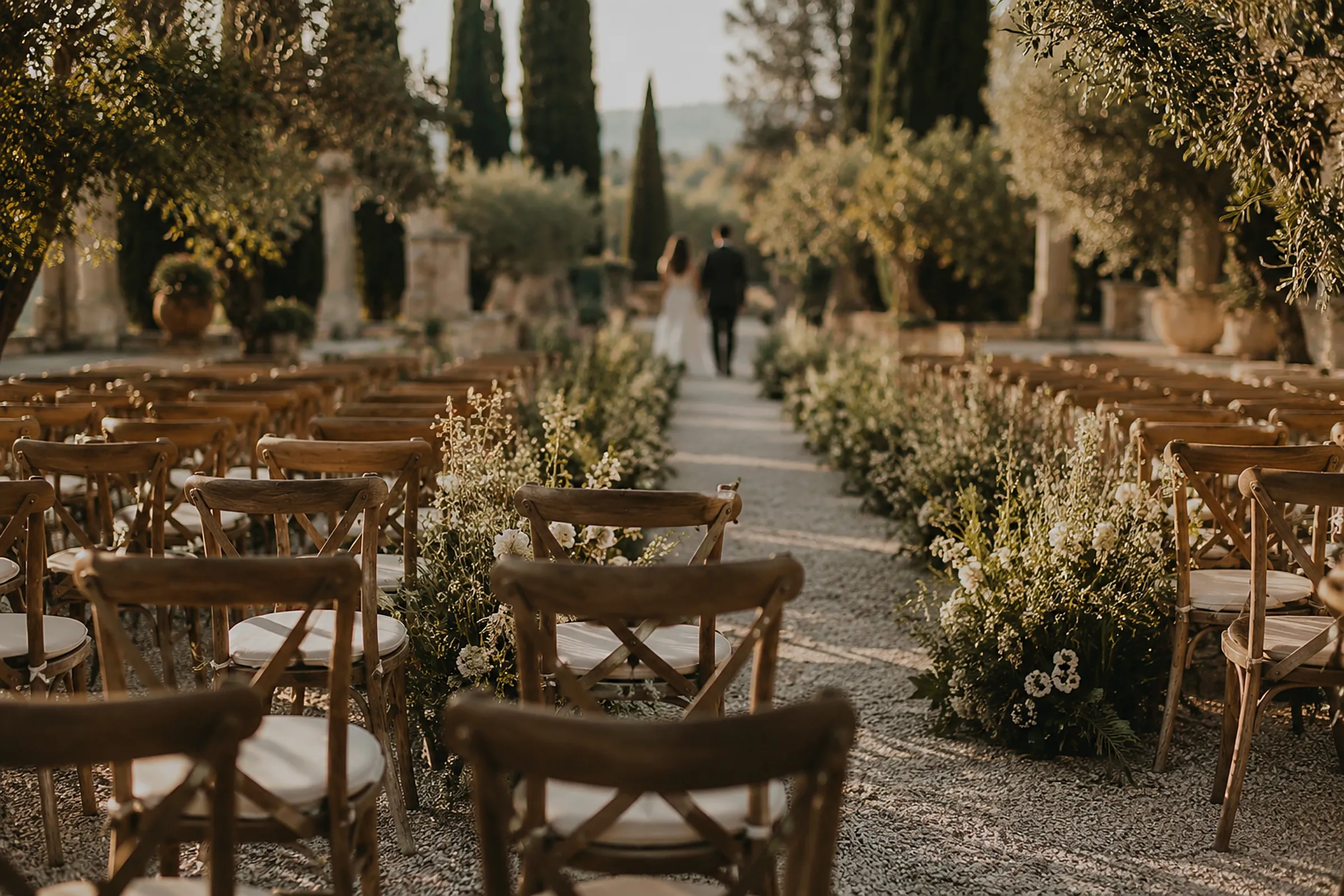
Leela looked past her to the cars waiting in a loose, impatient row. Somewhere in the city, the wedding had begun without her: flower stems cut, chairs arranged, someone tasting the first batch of tea. She was exhausted. Her hair smelled of rain and train metal. The ground under her feet felt briefly unsteady. But when Nani slipped her arm through hers, Leela did not feel that she had arrived at a destination. She felt that she had joined a procession already in motion.
Honesty note: This is an original speculative edition of Aura Stories. The people, scenes, correspondence, and narratives are editorial fiction, written to explore the theme of distance in wedding life. They are not reported profiles, and no person depicted is presented as a real couple or guest.
Filed under
This story is part of the permanent collection of Aura Stories — yours to return to, always.
The Issue
The Issue. Twelve weddings a year, in your inbox.
One dispatch a month — the weddings, the makers, the taste behind them. No spam, leave whenever you like.
The conversation
Comments
No comments yet. Be the first to write one.
Sign in to comment