Night is when a wedding stops being shown and starts being lived.
An editorial thesis
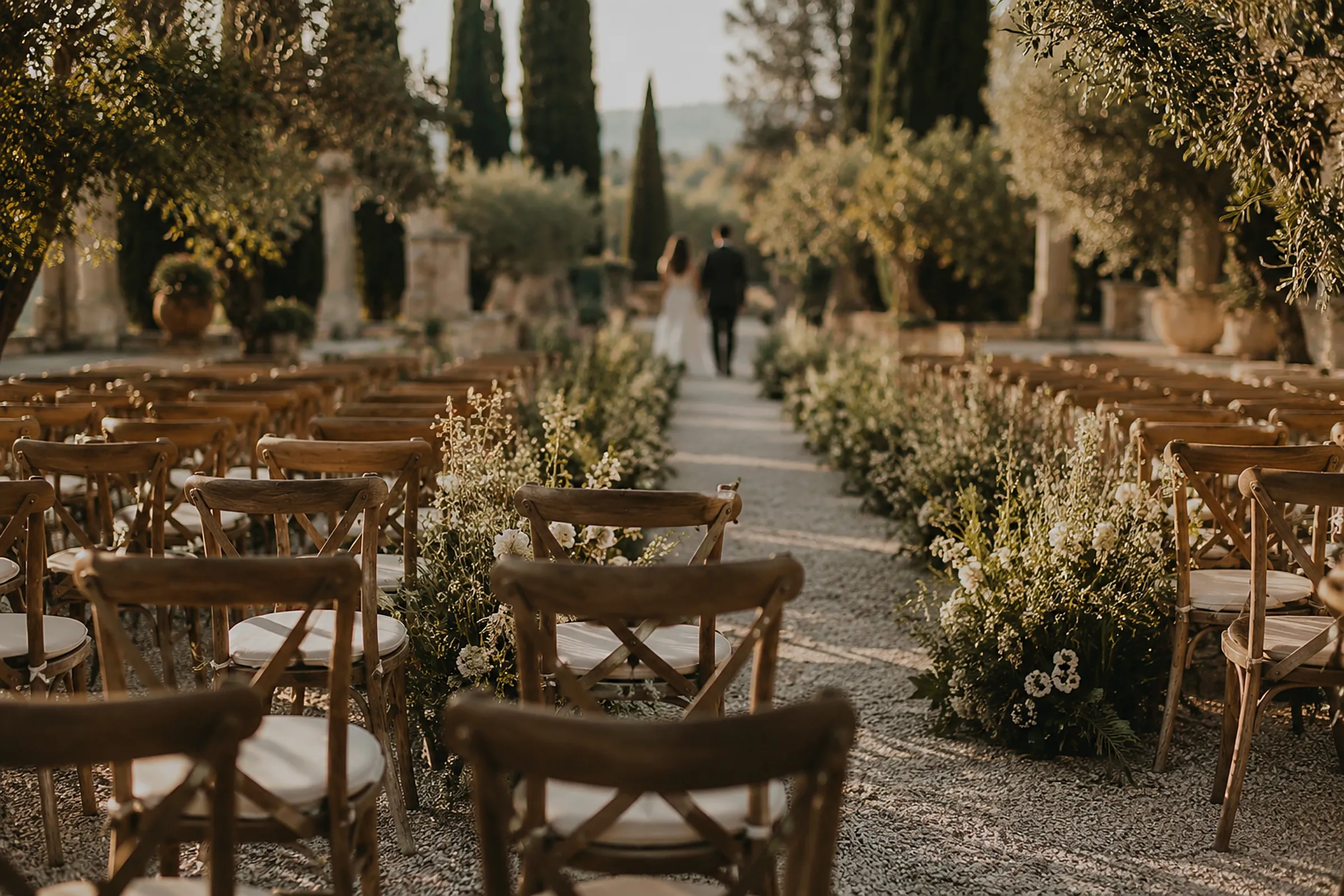
An editorial thesis
By the time a wedding becomes beautiful in the way people remember, some part of it has usually stopped being tidy. The schedule has been translated into glances. A pressed sleeve has acquired a mark from someone else’s lipstick. The person who swore they would leave at ten is sitting on the floor in a quiet room, listening to their sister tell a story they have heard before. Outside, the lighting plan has started to negotiate with weather, architecture, human eyesight, and the person responsible for finding the missing car.
This is not an argument against planning. Aura is built around the conviction that thoughtfulness makes feeling possible. But a wedding’s first job is often to declare itself: here is the room, here are the flowers, here is the couple as everyone has agreed to see them. Daylight is good at this. It holds surfaces still. It makes a terrace, a table, a face legible from across a lawn. It offers the gratifying evidence that thousands of decisions became an occasion.
Night asks for a different kind of intelligence. It reduces the field. It makes people rely on one another, on the handrail, on the person who knows where the water is, on the staff member who can tell at a glance that a candle has become a hazard rather than a mood. It restores scale to a room by allowing some of it to disappear. It makes the same group of guests more private with one another. The best evenings do not simply get darker; they get more specific.
That specificity is why we wanted this issue to look at the part of a wedding that is frequently condensed into a single phrase: after party. The phrase is too blunt for the thing itself. It misses the strange handover after dinner, when a formal room becomes a place to linger. It misses the labour of carrying light from daylight into evening. It misses the fact that a dance floor is a bodily environment before it is a photograph. It misses the parallel night taking place in service corridors, loading bays, kitchens, cars, and borrowed office chairs. And it misses the tender administrative work of getting everyone home.
The night does not remove a wedding’s formality so much as test what it was made of. If the day was built only for an image, the evening can make its emptiness visible. If it was built with enough ease—enough water, enough food, enough places to sit, enough clear decisions, enough room for people to take their own shape—then the evening can become unusually generous. People begin to act less like an audience. They stop checking whether they are in the right part of the story. They make one.
We have written these pieces from inside that shift. They are not commandments, nor a checklist dressed as philosophy. They are scenes and observations from the hour when perfection loses some of its authority. A candle that has to be moved is not a disappointment. A late coach is not automatically a disaster. A dancer sitting down is not a failure of energy. In each case, the question is what kind of care the moment has been given, and whether the people holding it have permission to respond without theatre.
This is a journal about the beauty seen imperfectly: through a reflection, an exhausted laugh, a grainy photograph, the cold edge of a champagne glass. It is also about the structures that make that beauty possible. The night can feel spontaneous because someone knew when to make the service entrance quiet, when to brighten the step, when to offer a plate of food without being asked, when to let the departure take its time. We are interested in the part that refuses a clean ending—not because chaos is inherently romantic, but because a wedding becomes real when it can survive being lived in.
Editorial note: A work of editorial fiction; people, places and makers are illustrative.
Filed under
This story is part of the permanent collection of Aura Stories — yours to return to, always.
The Issue
The Issue. Twelve weddings a year, in your inbox.
One dispatch a month — the weddings, the makers, the taste behind them. No spam, leave whenever you like.
The conversation
Comments
No comments yet. Be the first to write one.
Sign in to comment