The long way to yes.
What changes when we understand the wedding journey as part of the celebration itself?
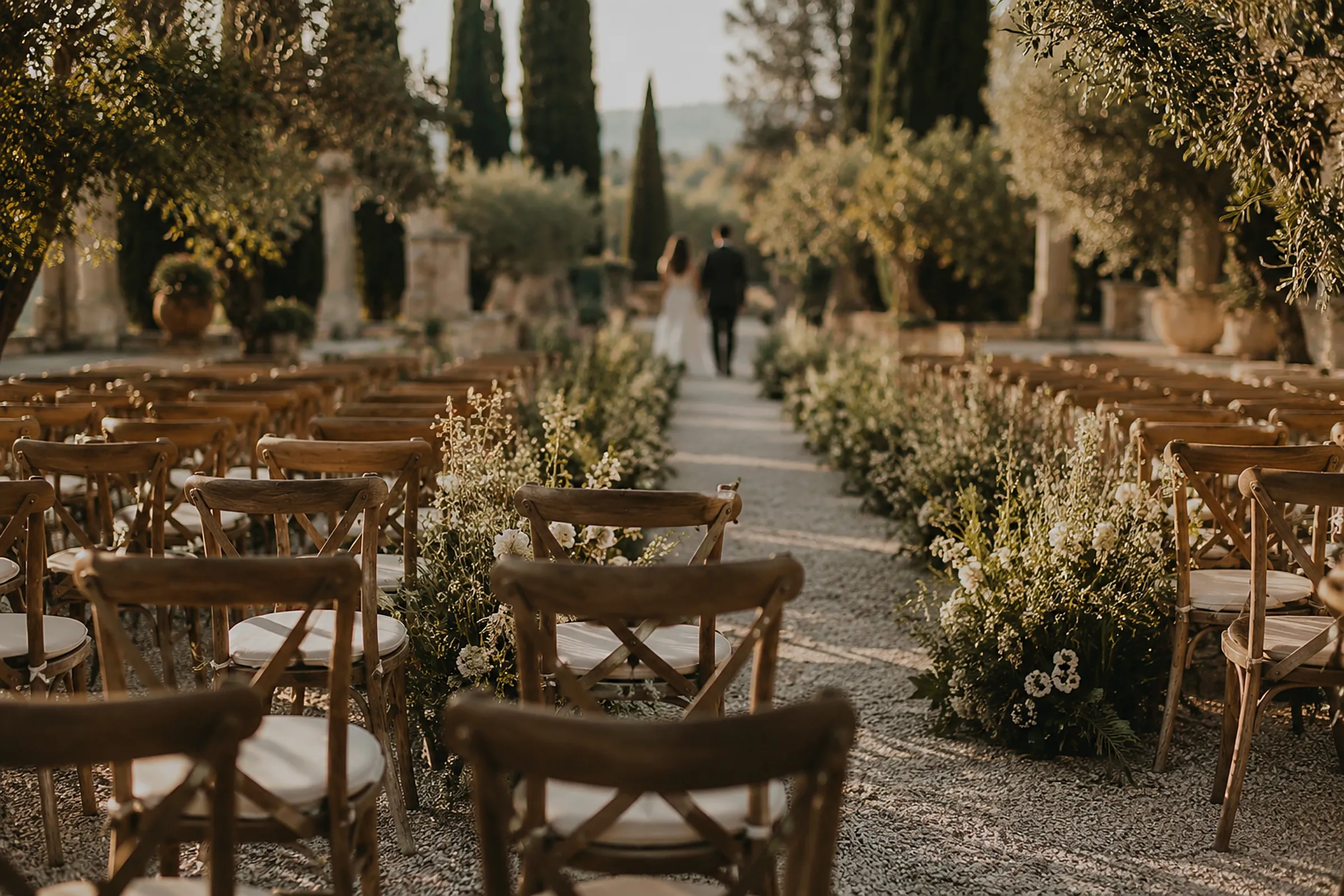
What changes when we understand the wedding journey as part of the celebration itself?
At 05:17, the departures board at Central Station has the soft indifference of something that has seen every kind of emotion and been asked to announce none of it. Its letters flip from place to place. A train to the coast. An overnight service. A delayed connection. On the far bench, a woman in an ivory suit sits with her bouquet standing upright between her knees, as though it needs its own ticket. She has not begun the day by becoming a bride. She has begun it by becoming a traveller.
Her name is Ines, and the reason she is on this bench and not in a hotel room near the town hall is her grandfather. Abel is ninety-one and no longer travels. Last night she ate soup with him in his kitchen, and when the dishes were done he asked her to hold her phone up so that he could say something to the wedding he would not see. It took him four attempts. On the third he forgot what he had meant to say and laughed, and she kept that one too.
So she has taken the first train instead of the night before. Her long dark coat is buttoned over the suit and the hood is up against the draught that comes down from the glass roof; from behind, at this hour, she could be anyone going anywhere. Her phone lights with a message from Tomas, who is already in the town where they will marry: Board says on time. I don’t believe it. She sends him a photograph of the bouquet, upright between her knees, and the word “passenger”.
This is the part of weddings we tend to soften into logistics: the routes, the bags, the extra night booked because a flight cannot be trusted, the cousin leaving work early to drive six hours, the uncle who needs an aisle seat, the mother crossing an ocean with a garment bag held above her head. Yet distance is not scenery around a wedding. It is often the first material the day is made from. Before flowers and vows, there is somebody looking at a map and deciding: I will go.
The list on the kitchen table
In March they had drawn it out on a single sheet of paper, the way other couples draw a seating plan. Not a guest list but a list of journeys. Vera, Ines’s mother, crossing an ocean with the garment bag she would not let anyone check. Uncle Rafael, who needs an aisle seat and says so early. Tomas’s cousin Oren, six hours by car. Aunt Mireille, whose knees have opinions about stairs. Jun, Ines’s oldest friend, who would arrive knowing nobody but the bride. Tomas’s grandmother Lidia, who had not left her own town in eleven years.
When the lines were drawn, they met nowhere in particular. That was how they chose the town: a small place with a town hall, a guesthouse, a courtyard house to rent and a railway line, roughly the same inconvenience from both families. It belonged to nobody. That was its qualification.
Travel turns affection into time. It asks people to give up an ordinary Tuesday, to wake before the first café opens, to learn the timing of an unfamiliar city, to arrive wrinkled and hungry and a little unsure of where to stand. When the gathering is far from the places that made its people, the act of arrival becomes more than attendance. It becomes a small declaration of belonging: your beginning matters enough for me to move my own life around it.
A destination wedding can make this legible. So can the wedding held in the town where one partner grew up, or at the halfway point between two families, or in the rented hall close to the last train. The scale changes; the geometry does not. Every wedding creates a temporary centre of gravity. Some guests circle it from next door. Others carry it across borders, language changes, school calendars, care responsibilities, and weather systems. The distance is not only measured in kilometres. It is measured in what a person had to arrange in order to be seen walking through the door.
Vera landed two days early. She carried the garment bag above her head down the aisle of the plane like a lantern, slept badly in the guesthouse, and on her first morning walked from the guesthouse to the town hall with her watch in her hand, so that she could tell everyone else exactly how long it took. Eleven minutes, she reported, nine if you do not stop to look at the bakery. Nobody had asked her to. It was the first thing she could do for the day with her own feet.
The most generous celebrations understand this without turning it into theatre. They make the route visible in small, usable ways: an arrival window that is genuinely forgiving; a meal waiting after a late flight; a cousin assigned to meet the grandparents at the station because she offered, not because she was quietly drafted. They name the hotel nearest the venue, but also the road that floods after rain. They give a map, yes, but they also give the local taxi number, the right entrance, the point at which the family will stop taking photographs and let everyone eat.
Kasia, Tomas’s sister, had offered in March to meet Lidia off the train, and had written it in her diary the same evening so that nobody could later mistake it for a favour extracted. The welcome sheet Ines wrote for everyone else ran to one page. It named the guesthouse and the courtyard house, and then the things nobody would think to ask: the taxi number that answers on a weekend, the side door of the town hall with the ramp, the lane behind the bakery that floods after rain, and the moment, written in bold, at which photographs would stop and dinner would begin.
There is romance in a grand crossing, but there is dignity in reducing friction. A wedding should not demand that guests prove their love through inconvenience. It can honour the journey by making room for its actual shape: for the child who needs a pause, for the friend who arrives without knowing anyone, for the aunt who takes a slower route because the faster one asks too much of her knees. Hospitality begins long before the welcome drink. It begins when someone opening an itinerary feels that a real person considered where they would be coming from.
Mireille’s route took two trains instead of one, with a change at a station that has a lift, and the second train was the slow one that stops everywhere. Ines booked her the ground-floor room for two nights, so that the journey home could be slow too. Jun was assigned to Oren, who picked him up at the junction on his way through and handed him a bouquet for Vera that the florist had not been able to deliver, to keep steady on the back seat for the last two hours. By the time they parked, they had argued about music twice and agreed on lunch.
The last leg
Ines’s train was not on time. A signal fault outside a station she had never heard of held it for twenty-two minutes, and then the connection to the town ran as a bus. She stood at the back of it with the bouquet against her chest and read Abel’s four messages again with the sound off. At the bus stop Sana, her younger sister, was waiting with a bottle of water and her own good shoes in a bag, in case the heels had not survived. They had. She walked the last stretch past the bakery without stopping, which made it nine minutes.
At the town hall the room was full, and almost everyone had come further than the room could see: Rafael from his aisle seat, Oren and Jun from their six hours, Lidia from her eleven years at home. Only Mireille was still on her way, on the slow second train, with Kasia, who had met Lidia’s train the day before, waiting at the station to bring her the last eleven minutes.
By afternoon, the woman from the station has reached the town hall. Her suit has gathered a small crease at the elbow; the bouquet has opened in the heat. Later, nobody will remember the exact platform. They will remember that she arrived just as the music started, one hand still on the strap of her overnight bag. They will remember the way the couple looked toward the door before they looked at one another. This, perhaps, is what a wedding receives when it asks people to travel: proof that a shared life is not only a private destination. It is a place others are willing to find.
The door had opened again, that was all. Mireille came in on Kasia’s arm with her coat still buttoned, apologising to nobody, and the registrar waited without being asked until she was seated. Then Ines and Tomas turned back to one another. Everyone who needed to find them had.
“Your beginning matters enough for me to move my own life around it.”
Editorial note: A work of editorial fiction; people, places and makers are illustrative.
Filed under
This story is part of the permanent collection of Aura Stories — yours to return to, always.
The Issue
The Issue. Twelve weddings a year, in your inbox.
One dispatch a month — the weddings, the makers, the taste behind them. No spam, leave whenever you like.
The conversation
Comments
No comments yet. Be the first to write one.
Sign in to comment