Before the room speaks
At 4:17 in the afternoon, a wedding has not yet happened. There are cables under the chairs, a prayer card on a piano bench, and a group of people learning exactly how much silence a room can hold.
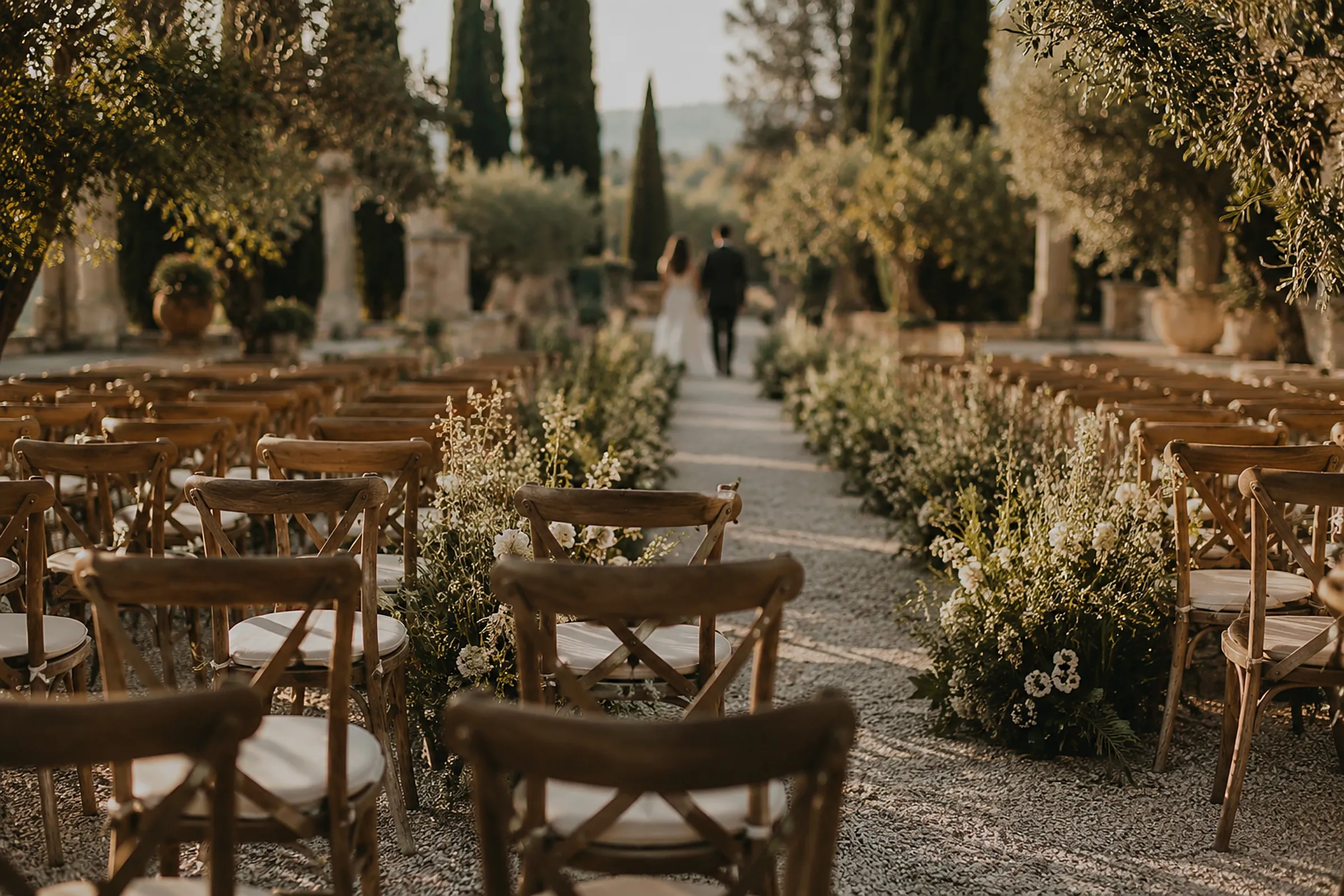
At 4:17 in the afternoon, a wedding has not yet happened. There are cables under the chairs, a prayer card on a piano bench, and a group of people learning exactly how much silence a room can hold.
Four hours before
The room is still mostly a worksite. The flowers have arrived too early and are waiting in buckets along the back wall. A ladder leans against a stone column. On the stage, a technician in a black shirt kneels beside an open case of cables, pulling a length of black wire through her hands as if testing a rope. Nothing about the action is theatrical. It is the opposite of theatrical: the work that makes theatre possible without being seen. In two hours, people will enter this room and decide that it has always been ready for them. For now, it is full of questions.
Where does the reader stand? Which microphone belongs to the officiant? Does the string trio need a monitor, or will it only encourage them to play for themselves? A voice carries differently under a high plaster ceiling than it does beneath a tent; a promise can leave the mouth clear and arrive at the last row as an indistinct weather. The technician walks to the back of the room, listens to an empty speaker, then asks the couple to say a sentence. Not their vows. Something ordinary. One of them says the name of a dog. The other says, with a laugh that is too quick to be casual, ‘Testing, testing.’
The word testing sounds ridiculous until it does not. A wedding is made of tests that are disguised as choices. Will this room let the grandmother be heard? Will the musician’s first note arrive before the doors open? Will a person who speaks softly feel pressured to become someone else for the sake of a hundred guests? The answers are made now, while the chairs are empty and nobody is trying to look moved.
The first instruction
The couple have asked for one thing in particular: before the entrance, no music. The request has been repeated in emails and then repeated again at the rehearsal, where it sounds less like a preference than a small act of defiance. Someone on the planning team worries that silence will make the room restless. A cousin suggests a soft instrumental track. The technician asks a more useful question: how long? Thirty seconds is a pause. Two minutes is an event. The couple look at one another. ‘Long enough for people to notice,’ one of them says.
It is a deceptively difficult request. Silence cannot be faded in. It has to be protected. The service door needs to be closed before it begins. The photographer needs to stop directing. The band needs to know not to fill the gap. Guests need a cue that they are not waiting for a mistake to be fixed. In a schedule full of named moments—processional, welcome, reading, kiss—the silence has no standard line item. Yet it may be the most exact expression of what the couple want: not a reveal, not a performance, but a shared change of attention.
The sound team calls it a hold. The word is practical and perfect. Hold the room. Hold the doors. Hold the question of who will enter and what will be asked of everyone once they do. The silence is not neutral. It gives weight to the person about to cross the threshold. It also gives weight to the people who are waiting. For once, no one gets to look away without feeling it.
Rehearsal is a negotiation
At the rehearsal, the string player begins the processional and stops after four bars. The tempo is beautiful, but it is too quick for the entrance from the far corridor. The planner wants to solve this with a mark on the floor. The musician suggests a longer opening instead. The couple’s parents, seated in the front row, look surprised by how much of a wedding can be decided in six seconds of music. The violinist plays again, with room between the phrases this time. Someone begins walking. The effect is immediate: the walk acquires a pace that does not look borrowed from a video.
This is the part of a rehearsal that is frequently rushed: the point at which the music stops being a selection and begins to become social infrastructure. Tempo determines who can move without panic. Volume decides whether children flinch. A key change can make a reader who has been holding herself together suddenly unable to speak. The musician cannot know these things alone. The people in the room have to say what the room is for.
One partner has brought a family prayer that their aunt will speak in a language many guests do not know. The other has brought a line of poetry their brother will read in English. The first instinct is to arrange them like competing elements: brief translation, then poem; prayer at one minute, reading at one minute; equality measured by stopwatch. The aunt objects, gently. The prayer is not long because it has too many words, she says. It is long because it names people who are not present. Nobody tries to shorten it after that. Instead, the technician moves the microphone stand lower and asks the aunt to rehearse from the place where she will sit.
The voice at the edge of the room
The aunt does not project. She is not meant to. At home, she prays at the end of a table, where people know to quiet themselves because they know her. In the ballroom, she begins close to the microphone, then pulls back when she hears herself amplified. Her voice becomes thinner. The technician adjusts the gain, but she does not turn it up all at once. She asks the aunt to begin again. ‘You don’t need to reach the room,’ she says. ‘Let the room reach you.’ It is a technical instruction, but the parents in the front row visibly understand it as something else.
There are a thousand versions of this moment in a wedding day. The person who has the social authority to speak may not have the physical confidence to use a microphone. The person with the clearest English may not be the person whose words matter most. The youngest member of a family may be asked to translate an elder into a language they do not actually possess. Sound work, at its best, notices this gap. It does not force every voice into the same shape. It makes the conditions under which different voices can remain themselves.
The rehearsal is interrupted by laughter from behind the service wall. It begins with one person and becomes three, the uninhibited kind of laughter that belongs to people working a long day together. Someone is trying to carry a tray through a door that is too narrow. For a moment, the room hears it all. The planner starts to apologise. The couple do not. One of them smiles, then says, ‘That stays.’ The technician smiles too, although no one is sure whether she has heard the request as a joke.
Who gets the clean room
The question is not whether a wedding can be perfectly controlled. It cannot, and trying too hard usually leaves the staff doing impossible work so that the illusion of ease can survive. The more interesting question is what kind of imperfection a couple is willing to welcome. Laughter through a wall can make a ceremony feel interrupted; it can also remind everyone that celebration is a collaboration between people who are visible and people who are not. The choice depends on the room, the families, the moment. But it should be a choice, not an accident made by someone lower in the chain of command.
This is where sound reveals power. A clean room is expensive. It requires enough crew, enough time, enough access to private space that the people preparing the celebration can disappear at the exact moment guests arrive. There is nothing wrong with wanting that stillness. But the wish becomes more honest when it recognises its conditions. If silence is desired, someone has to be given the resources to make it. If a spontaneous family song is desired, someone has to know how to put a microphone in the right place without turning the singers into performers for the room.
The technician’s work is a form of hospitality that can be easy to overlook because it has no obvious emotional climax. She marks a cable path with tape so an elder will not catch a heel. She asks the caterer when the ice machine will run. She moves the speaker that will blast a guest in the face during dinner. She tells the band which part of the room will need less volume because a baby will sleep there. Every decision says, quietly, you belong in the experience we are making. Every omission says something too.
The entrance
By the time guests have arrived, the room has acquired its second life. The cables are hidden. The prayer card is in a pocket. The flowers have been lifted from their buckets and are doing their work. People have started speaking in the tones they use when they believe a day is already special. In the corridor, the couple stand with the people who will enter before them. Nobody is sure where to put their hands.
Then the hold begins. The technician watches the stage, then the back of the room, then the service door. The air-conditioning drops to its overnight hum. A spoon is set down. A child asks a question and is answered by a parent’s hand on their shoulder. The silence is not total; it is made of the sounds people allow to remain when they stop making new ones. Thirty seconds pass. Then another thirty. The room becomes conspicuously present to itself.
When the first person steps through the doorway, there is no swell to tell the guests what to feel. The violin comes later, after the first few steps. The sound has not been removed. It has been given a reason to begin. The aunt’s prayer follows, then the brother’s reading. At the back, behind the service wall, there is another burst of laughter—smaller now, carefully swallowed. The couple hear it. So do the guests closest to the wall. Nobody turns. The room has already decided what it is holding.
After the test
Hours later, after the speeches and the dance floor and the last logistical request have passed through the headset, the technician will fold her cables into their case. She will find a torn place card, a flower head, a strip of tape with a word written on it: HOLD. The room will have forgotten the level checks, the second rehearsal of the prayer, the question of whether the silence was too long. That is the strange success of technical work. It disappears into the experience it made possible.
But the couple may remember it differently. Not as a sound system, and not even as silence. They may remember the moment before the doors opened as a sensation of being granted time by everyone they loved. They may remember their aunt’s unhurried voice and the laughter beyond the wall. They may remember the violin arriving after they had already begun to walk. These are not effects. They are evidence of a room being asked to listen, and agreeing.
A soundcheck is not a prelude to the real thing. It is where a room declares whose presence it is prepared to carry.
Editor's note: A fictional composite about rehearsal, technical sound work, prayer, the entrance, and the choices that make attention possible.
Filed under
This story is part of the permanent collection of Aura Stories — yours to return to, always.
The Issue
The Issue. Twelve weddings a year, in your inbox.
One dispatch a month — the weddings, the makers, the taste behind them. No spam, leave whenever you like.
The conversation
Comments
No comments yet. Be the first to write one.
Sign in to comment